Jesus replied, "I tell you the truth, you want to be with me because I fed you, not because you understood the miraculous signs. (John 6:26 NLT)Why do we become Christians? Is it for our selfish gain? This passage in John 6 follows the feeding of the 5,000. These Jews were excited that Jesus could provide for their physical needs like God provided mana from heaven. But like the Israelites in the old testament they miss the point of Jesus' provision. Jesus is not a divine miracle vending machine. He is the bread of life. We follow Christ not for what he can give us (blessings) but because we recognize who He is. Jesus performed miracles to help us get a glimpse of God's kingdom and our King, Jesus. Why do you want to be with Jesus? To be with Him? Or are we merely using Jesus to get something we want?
Showing posts with label scripture. Show all posts
Showing posts with label scripture. Show all posts
Tuesday, July 26, 2011
Motivations

Tuesday, October 26, 2010
Selective Bible Reading?
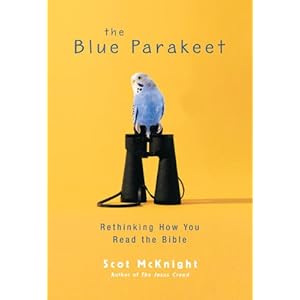
After a good break, I began to take in new thoughts, ideas, books, blogs to further explore. One interesting person I've found is a New Testament scholar named Scott McKnight. Scott might be best known for his book Jesus Creed which I recently finished. But I'd like to talk about his most recent book The Blue Parakeet: Rethinking How You Read the Bible.
In the book Scott talks about how there are passages in the Bible that stand out and are hard to explain. One point he makes in the book that has spoken to me is about selective Bible reading.
When I was growing up and began to read my Bible for myself, I noticed that there were some difficult to understand passages in it. Going to Sunday school, and later youth group I was taught that we were to follow and obey all the words of the scriptures. But here was the growing problem: I noticed that Christians would follow some verses and not others. It's not that they were willfully disobeying scriptures it's just that it seemed to me they were taking some passages more seriously than others. Let me give an example:
"Now I want you to realize that the head of every man is Christ, and the head of the woman is man, and the head of Christ is God." 1 Corinthians 11:3
"If a woman does not cover her head, she should have her hair cut off; and if it is a disgrace for a woman to have her hair cut or shaved off, she should cover her head" 1 Corinthians 11:6Why is it that there are so many churches that are quick to jump on 1 Cor. 11:3 to show that men are to be the head or leaders of women but no one (or very few) practice 1 Cor. 11:6 and require their women to cover their heads in prayer? Do we just pick the verses we like and support our opinions and throw out the ones we disagree with?
This is just one example of dozens I could point out. At first glance it appears that Christians follow what they want in the Bible and ignore that which they don't like or agree with.
What if there is another way to read the Bible that doesn't result in us holding some verses over others or picking and choosing what we will believe and follow? What if the Bible as a whole is saying something about God and His story and interaction with humanity? What if the Bible is more complex and nuanced than we were once taught? And what if the Holy Scriptures were never meant to be read and understood alone by ourselves in our "personal devotions?"
Recently I've been searching for a way to read the Bible while recognizing it's mystery, difficulties, and with an understanding that we can't just cut up the Bible into little bite size verses, yank them out of context and base whole belief systems on them. Scott McKight's book The Blue Parakeet is beginning to show me a way forward from: How do I understand the Bible? To: How do I live the Bible?
Your thoughts? What are some examples you've seen of selective Bible reading? How do we learn to follow all of God's word and not just parts?
Thursday, August 21, 2008
For those Christian leaders who come off as jerks
I've heard a lot of very well meaning Christian leaders in the name of being honest and straight forward virtually explain away the fact that a lot of times, they come across as arrogant jerks.
I agree that we should share the truth in love... the thing is, I think we have a low view of what love is. While I'm a full advocate of "tough love," what I have been reading recently in the scriptures seems to clearly define what love is (and isn't)
So when we share the "truth in love" - are we being patient, kind, not rude, not angry, to protect others, etc. I know that for me personally, loving others no matter what is probably the hardest thing about being a follower of Jesus Christ. To love unconditionally in a way that is civil, kind, and considerate of not just my agenda, but God's love and work in the lives of others as well.
So what do you think? How do we speak the truth in love without coming off as jerks?
I agree that we should share the truth in love... the thing is, I think we have a low view of what love is. While I'm a full advocate of "tough love," what I have been reading recently in the scriptures seems to clearly define what love is (and isn't)
1 Corinthians 13:1-13
1If I speak in the tongues of men and of angels, but have not love, I am only a resounding gong or a clanging cymbal. 2If I have the gift of prophecy and can fathom all mysteries and all knowledge, and if I have a faith that can move mountains, but have not love, I am nothing. 3If I give all I possess to the poor and surrender my body to the flames, but have not love, I gain nothing.
4Love is patient, love is kind. It does not envy, it does not boast, it is not proud. 5It is not rude, it is not self-seeking, it is not easily angered, it keeps no record of wrongs. 6Love does not delight in evil but rejoices with the truth. 7It always protects, always trusts, always hopes, always perseveres.
8Love never fails. But where there are prophecies, they will cease; where there are tongues, they will be stilled; where there is knowledge, it will pass away. 9For we know in part and we prophesy in part, 10but when perfection comes, the imperfect disappears. 11When I was a child, I talked like a child, I thought like a child, I reasoned like a child. When I became a man, I put childish ways behind me. 12Now we see but a poor reflection as in a mirror; then we shall see face to face. Now I know in part; then I shall know fully, even as I am fully known.
13And now these three remain: faith, hope and love. But the greatest of these is love.
So when we share the "truth in love" - are we being patient, kind, not rude, not angry, to protect others, etc. I know that for me personally, loving others no matter what is probably the hardest thing about being a follower of Jesus Christ. To love unconditionally in a way that is civil, kind, and considerate of not just my agenda, but God's love and work in the lives of others as well.
So what do you think? How do we speak the truth in love without coming off as jerks?
Friday, May 30, 2008
My strength this next week:
"Not by might nor by power, but by my Spirit,' says the LORD Almighty"
Zechariah 4:6
Friday, February 29, 2008
The Hermeneutics Quiz
I just took a quiz on how I interpret the bible... fascinating the questions asked. It a Hermeneutics quiz created by Scot McKnight for Leadership Magazine. You can take the quiz online here
I scored a 53 which (barely) puts me in the "moderate" category of interpretation. Take the quiz and post your score in the comments section here.
I scored a 53 which (barely) puts me in the "moderate" category of interpretation. Take the quiz and post your score in the comments section here.
Friday, December 14, 2007
His Love Endures Forever
"Give thanks to the Lord, for he is good. His love endures forever."Nestled in the Psalms is Psalm 136. As I was reading this morning, I couldn't help but notice the cadence and rhythm of this song. After every line, there is the phrase "his love endures forever." This got me thinking... as I reflect on God's creation, the world and everything in it - God's love is manifested in every crack and crevice of this universe.
I wake up in the morning - His love endures forever
I take a warm shower - His love endures forever
I eat breakfast - His love endures forever
I drive a car to work - His love endures forever
I have a family - His love endures forever
I live in a stable, rich country with many freedoms - His love endures forever
I have a bad day - His love endures forever
I am strapped financially - His love endures forever
I'm feeling lonely - His love endures forever
I don't feel like getting out of bed - His love endures forever
I loose someone I love - His love endures forever
The earth feels like it is crashing down all around me... His love endures forever
Insert your own statement about life, the universe or anything - His love endures forever
We live in a world that is wrapped in the love of God. Sure it doesn't feel like it, but I believe it is God's love that keeps things from falling (completely) apart. It's the love of God that caused Him to send his only Son to die a brutal death so that we may never have to be separated from His love. It's the love of God that caused Him to create us in the first place... to give us a choice, a free will because love isn't complete unless there is the capacity for reciprocation and an option not to love.
Give thanks to the God of heaven - His love endures forever
Subscribe to:
Posts (Atom)